Video Editing Agency Retainer Margin & Editor Utilization Benchmarks (2026)
Target 55% to 65% [Agency Analytics & Post-House Benchmarks, 2025] gross delivery margin per retainer seat; control utilization and revision costs.

A retainer may post impressive sales figures while quietly absorbing an editor’s week for a weak return on delivery. The leakage tends to show up in three areas: unlogged client time, revision scope with no practical ceiling, and delivery commitments issued before anyone checks available capacity.
Begin by costing each seat and each deliverable. Utilization and revision records can then show whether the account calls for revised scope, different pricing, or a cleaner production process.
| Measure | Benchmark | Management use |
|---|---|---|
| Gross delivery margin | 55% to 65% Agency Analytics & Post-House Benchmarks, 2025 | Target per productized retainer seat, before overhead and sales costs |
| Billable editor utilization | 65% to 75% Promethean Agency Operations Benchmark, 2025 | Reserve the balance for necessary nonbillable work |
| Structured review | Median 2.4 rounds Frame.io Workflow Study, 2025 | Compare with 4 or more rounds [Frame.io Workflow Study, 2025] through unthreaded email feedback |
Treat these figures as planning references, and build targets from the performance of the agency’s own accounts before turning any of them into an operating forecast.
What gross delivery margin should a video editing agency target per retainer seat?
For a productized editing retainer, the table’s range offers an initial margin target. Gross delivery margin means the revenue remaining once direct delivery costs have been paid; management, sales, general software, facilities, and profit still come out of that balance.
Apply one calculation method throughout:
Gross delivery margin = (retainer revenue − direct delivery costs) ÷ retainer revenue
Include fully loaded editing labor in direct costs, together with account-specific producing and review, freelancers, and any other expense attributable to that client. Shared delivery labor should be allocated from recorded hours. Set a policy up front for client-specific software and pass-through expenses, then apply it uniformly to every account.
Consider an illustrative allocation in which one seat generates $100 of retainer revenue. With editing at $24 and producing plus review at $11, gross delivery margin comes to 65%.
An additional revision that contributes $10 of direct labor and no extra revenue pulls that margin down to 55%. The delivery obligation expanded even though the fee remained fixed.
Averages at seat level can conceal a costly output. Spread the revenue assigned to that seat across the promised deliverables under a consistent allocation method, and set each output’s share against its direct labor and remaining delivery expenses. A complex YouTube edit can quietly draw support from a recurring short-form cut until the output mix shifts. Check the full account and its deliverable mix ahead of renewal.
For production planning, a separate reference puts post-production for polished YouTube work at an average of 30 to 60 minutes ProductionHUB & Editorial Rate Survey, 2025 per finished minute. Before preparing a quote, treat that figure as an initial estimate: source footage, graphics, audio repair, and approvals can all push a particular job well beyond that range.
What is a sustainable billable utilization rate for full-time Premiere Pro editors?
The table’s benchmark leaves capacity for necessary editor work that has no specific client to charge. Internal template maintenance, training, and general equipment or workflow administration fall into that category. Contract terms and the agency’s allocation policy determine whether ingest and quality control count as billable.
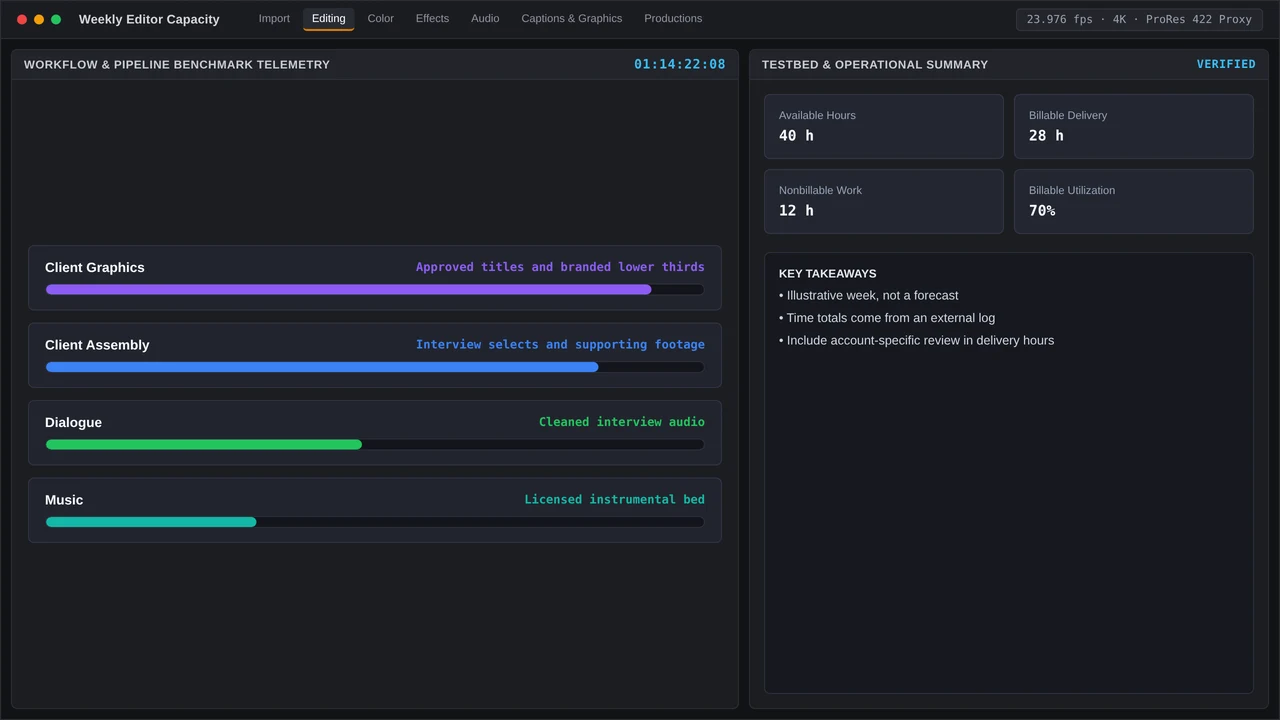
Apply this formula:
Billable utilization = client-chargeable delivery hours ÷ available paid work hours
Under a retainer, delivery work covered by the client’s fee qualifies as client-chargeable time even when no separate hourly invoice exists. Log those hours to the account, and leave internal administration classified as internal instead of moving it into client work to flatter the reported rate.
An editor with 40 available paid work hours in a week, for instance, would log 26 to 30 client-chargeable hours within that benchmark. The other 10 to 14 hours fund the nonbillable activity required to keep the seat running, so selling them automatically as unused capacity would be a mistake.
Base available hours on paid working time that remains after scheduled leave. Read utilization next to delivered volume and margin, since heavy activity on a low-margin account is possible, and even a profitable account can stop being sustainable when its workload is compressed into an unworkable turnaround.
How should a retainer’s turnaround SLA fit editor capacity?
Start the turnaround clock only after an accepted brief arrives. An incomplete file dropped into a folder does not establish that starting point. Specify the assets, feedback, and approvals required before timing begins, identify the business days that count, and explain the consequence of a missed client feedback deadline.
Before committing to a two-business-day turnaround, confirm that reserved production capacity exists inside that window for the account. A window whose capacity is already committed leaves the agency with an unfunded staffing promise. Quote a later slot, price the rush separately, or reduce the deliverable’s scope.
How do structured timecode review links reduce unbilled client revision rounds?
According to the workflow study cited above, structured links with pinned timecodes produce fewer review rounds than unthreaded email. The comparison has practical value, though it cannot prove that the link by itself caused the change. Discipline in the surrounding review process also affects the outcome.
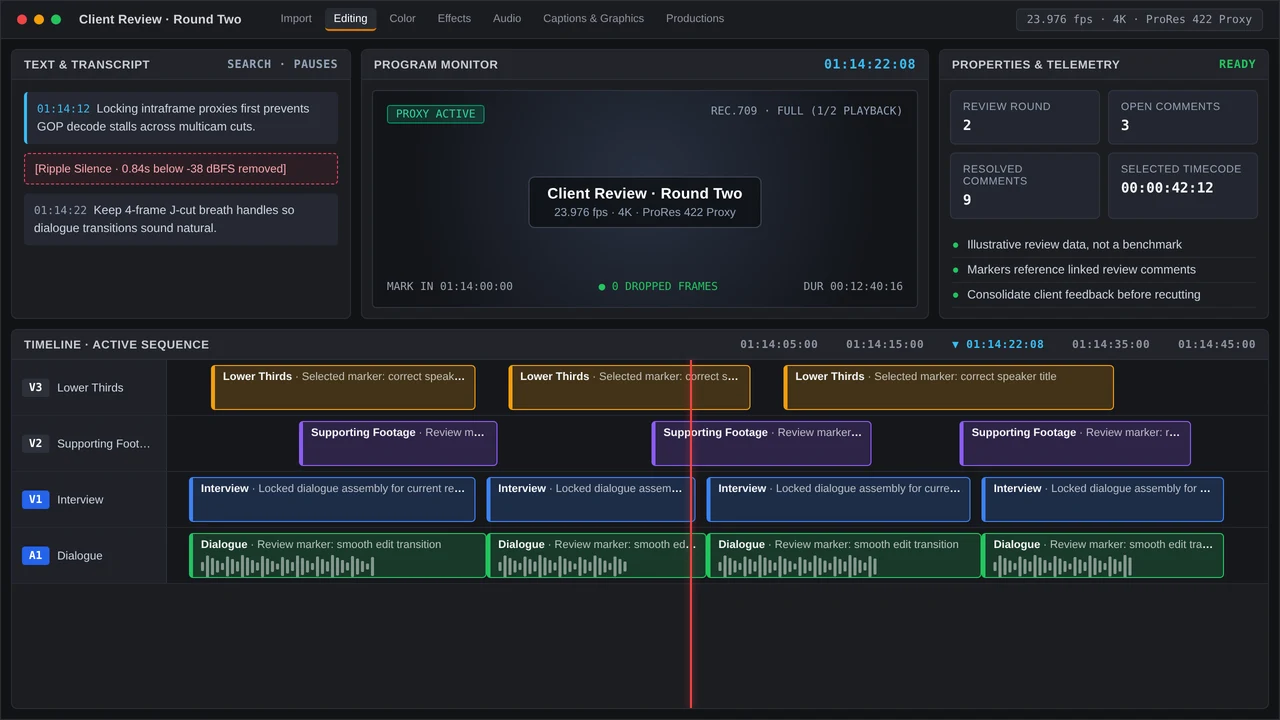
A practical policy contains four elements:
- One version, one review location. Upload the cut to Frame.io or another review system that supports timecode. Close out older links so every comment attaches to the current version.
- One consolidated client response. Have a client-side approver reconcile conflicting stakeholder notes before the response is submitted.
- A defined round. One consolidated note set on a delivered version counts as a single round. Feedback arriving after the agreed deadline can require another round.
- A change-control rule. State how many rounds the retainer covers, and quote any extra round or alteration to the approved brief before work starts. Agency corrections for its own errors should sit outside the client’s revision allowance.
Frame.io comments can sync with sequence markers in Premiere Pro. Handle transcript and caption work in the Text panel, make adjustments to selected graphics through the contextual Properties panel, and browse templates in the Graphics Templates panel. This workflow prevents the editor from rebuilding scattered feedback without compensation.
Track completed rounds, client feedback delays, and revision labor by account. Rising revision hours with rounds still inside the cap can point to a faulty brief or approval process. Margin protection requires more than a count of rounds.
Demand for video is extensive, with 89% Wyzowl State of Video Marketing, 2026 of businesses using it as a core marketing tool. Broad demand alone cannot make a retainer profitable. An account’s seat economics still depend on suitable contract terms, a workable capacity plan, and controlled review.
More in Billable Cut

Price rush editing with a scoped surcharge, billable utilization benchmarks, review caps, and weekend SLAs; protect margin with a practical QC plan.

Compare day rates and flat fees using billable utilization, gross-margin targets, revision caps, delivery hours, and practical contract clauses.